Shaolin Temple
Complete Guide to Shaolin Temple (Songshan Shaolin Temple)
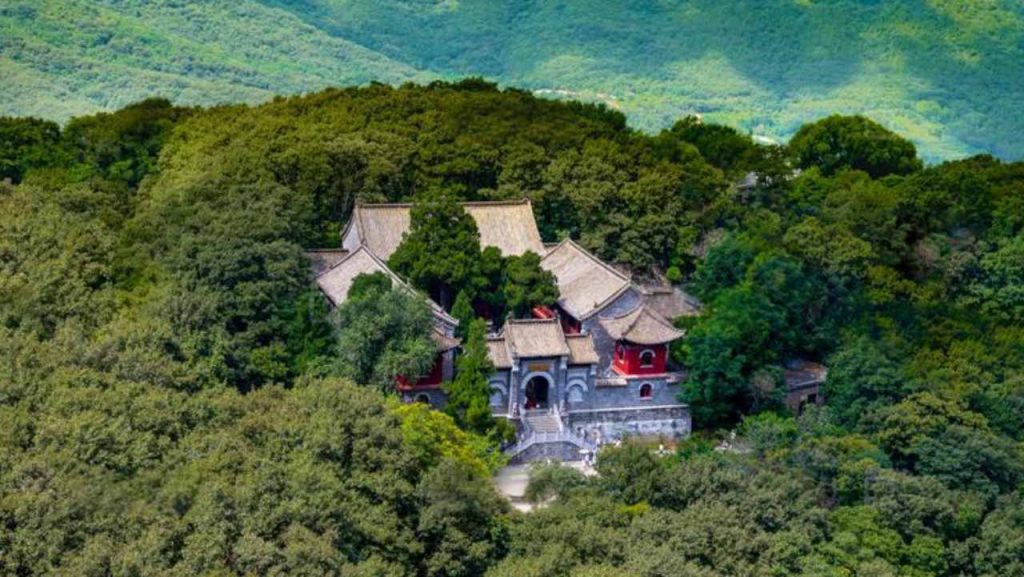
Shaolin Temple (full name: Songshan Shaolin Temple) is nestled at the foot of the Wuru Peak of Songshan Mountain and on the north bank of the Shaoxi River in Dengfeng City, Zhengzhou, Henan Province. It is the ancestral shrine of the Chan School of Chinese Buddhism and the birthplace of Shaolin Kung Fu. It holds multiple prestigious titles: a World Cultural Heritage Site (as the core component of the Historic Monuments of “the Centre of Heaven and Earth” inscribed in 2010), a Major Historical and Cultural Site Protected at the National Level, and a National AAAAA Tourist Attraction. It is renowned worldwide as “the No.1 Ancient Buddhist Temple Under Heaven”.
Historical Evolution (Over 1,500 Years of Rise and Fall)
- Founding in the Northern Wei Dynasty (495 AD)
In the 19th year of the Taihe reign of the Northern Wei Dynasty (495 AD), Emperor Xiaowen (Tuoba Hong) ordered the construction of a temple in the dense forests on the northern slope of Shaoshi Mountain, Songshan Mountain, to accommodate the eminent Indian monk Batuo (Buddhabhadra) for preaching Buddhism. The temple was named “Shaolin” after its location. Batuo served as the first abbot. A scripture translation institute was established in the temple, where distinguished monks such as Ratnamati and Bodhiruci translated Buddhist sutras, making Shaolin a pivotal hub for Buddhism in northern China.
- Foundation of Chan Buddhism (527 AD)
In the 3rd year of the Xiaochang reign of the Northern Wei Dynasty (527 AD), the great Indian monk Bodhidharma arrived at Shaolin Temple. He meditated facing a stone wall in a cave on Wuru Peak for nine years and first introduced the Mahayana Chan Buddhism, advocating the philosophy of “directly pointing to the human mind; realizing one’s original nature to attain Buddhahood”. He was honored as the First Patriarch of Chan Buddhism, establishing Shaolin Temple as the ancestral home of Chan Buddhism.
- Calamity in the Northern Zhou Dynasty (574 AD)
Emperor Wu of the Northern Zhou Dynasty suppressed Buddhism; Shaolin Temple was destroyed, monks were dispersed, and it was renamed Zhihu Temple. The temple was restored in the 2nd year of the Daxiang reign (580 AD). In the early Sui Dynasty, it regained its original name and was granted hundreds of hectares of farmland by the imperial court.
- Prosperity in the Tang Dynasty (618–907 AD)
At the end of the Sui Dynasty and the beginning of the Tang Dynasty, thirteen monk warriors assisted Li Shimin (Emperor Taizong of Tang) in defeating Wang Shichong. They received generous imperial rewards: granted farmland, exempted from grain taxes, and authorized to form a warrior monk regiment. The title “the No.1 Ancient Buddhist Temple Under Heaven” was officially established. The warrior monk system took shape, and the integration of Chan and Shaolin Kungfu emerged. The temple expanded to more than 5,000 buildings with over 2,000 resident monks.
- Continuation in the Song, Jin and Yuan Dynasties
Chan Buddhism split into five sects in the Song Dynasty; Shaolin Temple upheld the Caodong Sect as its orthodox lineage, which has been preserved to this day. During the Jin and Yuan Dynasties, the temple was revered by imperial families, with its architecture and Shaolin Kungfu continuously flourishing.
- Golden Age in the Ming Dynasty (1368–1644 AD)
The Shaolin Shaolin Kungfu system reached full maturity. A standing force of over 500 monk soldiers was maintained, who were repeatedly ordered by the imperial court to resist Japanese pirates and defend the border. The saying “All Shaolin Kungfu under heaven originate from Shaolin” became widely recognized. A vast number of boxing routines, weapon techniques and theoretical classics were compiled.
- Decline in the Qing Dynasty
The Qing imperial court adopted a policy of both supporting and restricting the temple. Emperor Yongzheng ordered large-scale renovations. Frequent wars in the late Qing Dynasty led to the loss of temple properties and the gradual decline of Shaolin Kungfu traditions.
- Modern Revival (After 1949)
- 1983: Designated as a Key National Buddhist Temple.
- 1982: The movie Shaolin Temple became a global blockbuster, sparking an international Shaolin craze.
- 1999: Shi Yongxin assumed the position of Abbot (the 47th generation of the orthodox Caodong lineage).
- 2006: Shaolin Kung Fu was included in the first batch of National Intangible Cultural Heritage List.
2010: The Main Temple Complex, Pagoda Forest and First Patriarch Hermitage were inscribed as World Cultural Heritage.
Core Architecture & Scenic Spots
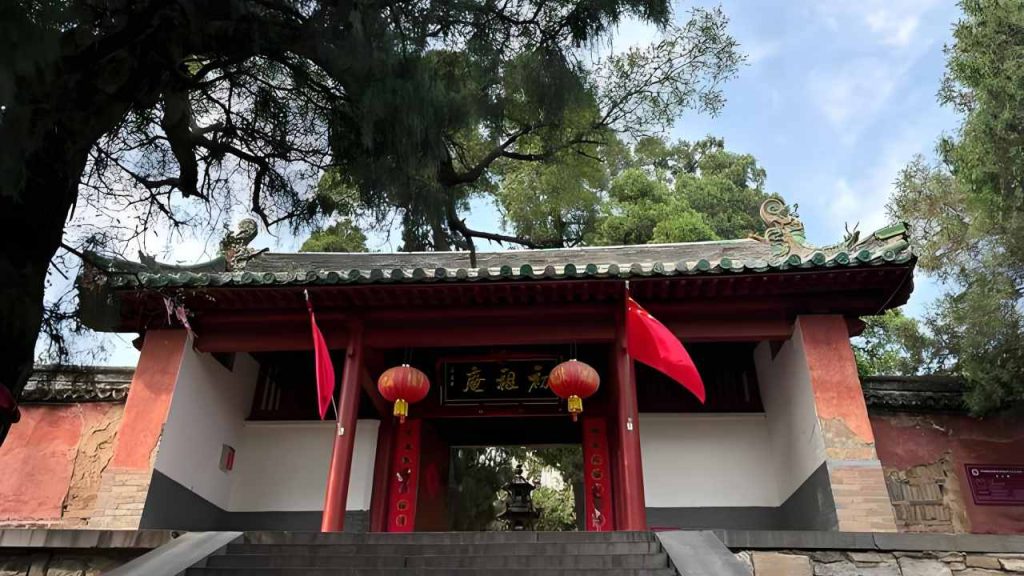
(1) Main Temple Complex (Core Area, Seven Courtyards, Covering 57,600 Square Meters)
Symmetrically distributed along the central axis with a height difference of 22 meters, dominated by architectures from the Ming and Qing Dynasties:
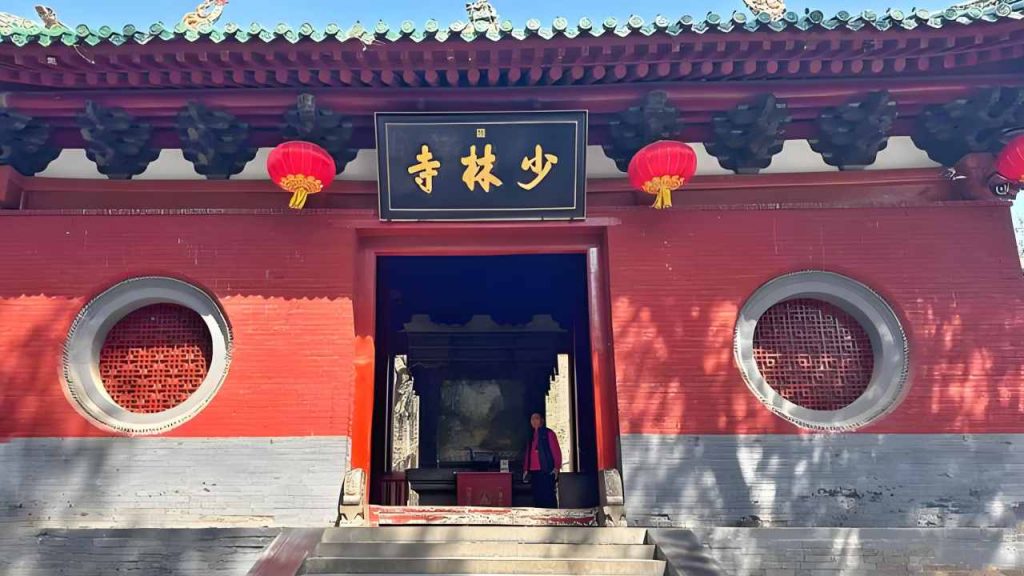
- Mountain Gate (Built in the Yongzheng Reign of the Qing Dynasty): A three-bay hall with a black-gold plaque inscribed with “Shaolin Temple” by Emperor Kangxi, engraved with the imperial seal “Treasure of Imperial Calligraphy of Kangxi”. Stone lions and ancient cypresses stand in front, serving as the main entrance of the temple.
- Heavenly Kings Hall (Founded in the Yuan Dynasty, Restored in the Ming and Qing Dynasties): Enshrines the Four Heavenly Kings, Maitreya Buddha and Skanda. Murals of warrior monks guarding the temple adorn the walls. Burned down in 1928, reconstructed in the 1980s.
- Mahavira Hall (Core Building): The spiritual center of the temple, housing the Three Buddhas (Sakyamuni, Medicine Buddha and Amitabha Buddha) and eighteen Arhats on both sides. The Imperial Stele of Emperor Taizong records the story of the thirteen monk warriors saving the Tang Emperor. Burned down in 1928, reconstructed in 1994.
- Sutra Pavilion (Dharma Hall): Once stored tens of thousands of Buddhist scriptures and Shaolin Kungfu manuals, destroyed in 1928. Now houses a white marble reclining Buddha donated by Myanmar, with the ruins of the Ksitigarbha Hall of the Ming Dynasty underground.
- Abbot’s Quarters: The residence of the abbot, with a Qing-dynasty plaque reading “Leader of Shaolin”. Emperor Qianlong once stayed here during his tours.
- Standing Snow Pavilion (Bodhidharma Pavilion): Built to commemorate the Second Patriarch Huike, who cut off his arm to seek the Dharma (standing in the snow all night to show sincerity and inherit teachings from Bodhidharma). A plaque inscribed “Snow Seals the Heart’s Essence” by Emperor Qianlong hangs here, a sacred site for the Chan lineage.
- Thousand Buddha Hall (Vairocana Pavilion): The largest building in the temple (seven bays wide). Enshrines Vairocana Buddha, with a 300-square-meter Ming-dynasty mural of 500 Arhats paying homage to Vairocana on the four walls. Forty-eight footprints about 20 centimeters deep on the ground are physical evidence of generations of warrior monks practicing stance training.
- 8.Auxiliary Buildings on Both Sides: Bell Tower, Drum Tower, Sixth Patriarch Hall, Kinnara Hall, White Robe Hall (decorated with murals of Shaolin boxing manuals and the thirteen monk warriors saving the Tang Emperor), Manjusri Hall, Samantabhadra Hall, etc.
- 9.Stele Forest: Preserves 174 ancient steles from different dynasties, including calligraphy works by Su Shi, Mi Fu, Dong Qichang and other masters, as well as precious historical relics such as the Imperial Stele of Shaolin Temple at Songyue Mountain (recording the Tang imperial rewards).
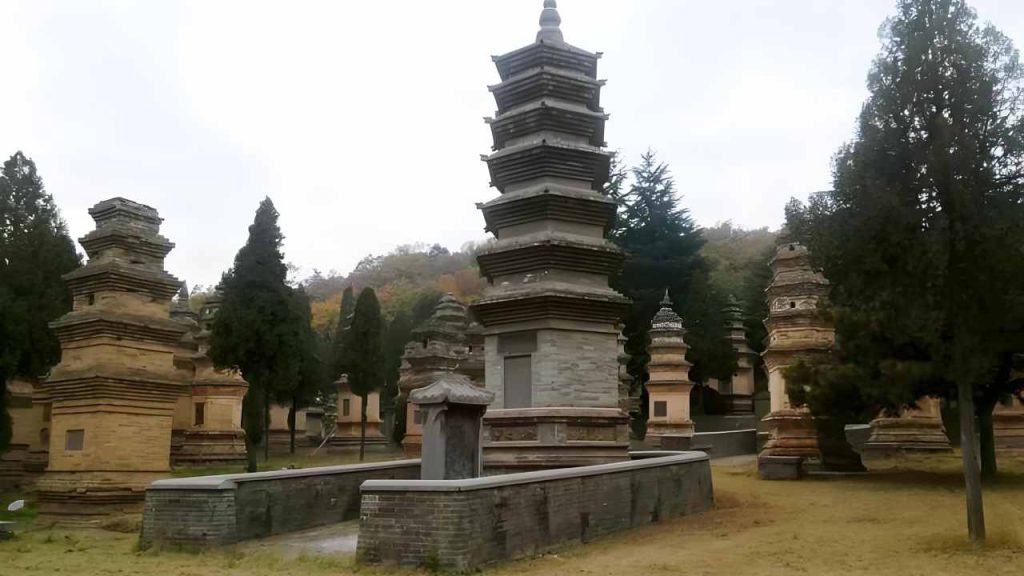
(2) Pagoda Forest (World Heritage, 300 Meters West of the Temple)
The largest existing ancient pagoda complex in China, covering about 20,000 square meters. It contains 248 brick and stone memorial pagodas from the Tang to the Qing Dynasties and 3 modern pagodas.
- Function: Mausoleums for eminent monks of all dynasties; their ashes or relics are buried in the underground palaces, with life stories and merits engraved on the pagodas.
- Structure: Ranges from 1 to 7 stories (the seven-storied Buddhist pagoda), with diverse shapes including square, hexagonal, cylindrical and vase-style. Known as an “open-air stone carving art museum”, it is a tangible archive for researching architecture and Buddhist history from the Tang to the Qing Dynasties.
(3) First Patriarch Hermitage (Built in 1125 AD, Northern Song Dynasty)
Erected in memory of Bodhidharma’s nine years of wall meditation, it is the oldest surviving building in Shaolin Temple. Its wooden structure, bracket sets and stone carvings are classic examples of the Yingzao Fashi (State Building Standards of the Song Dynasty), holding extremely high academic value in architectural history.
(4) Bodhidharma Cave (On Wuru Peak)
A natural grotto where Bodhidharma meditated facing the wall for nine years. The “Shadow Stone of Bodhidharma’s Wall Meditation” (legend says his figure was imprinted on the stone) and numerous ancient inscriptions can be found inside.
(5) Other Attractions
Second Patriarch Hermitage, Third Patriarch Hermitage, Ten Directions Chan Courtyard, Sweet Dew Platform and other sites form a complete cultural space integrating Chan and Shaolin Kungfu.
Shaolin Kung Fu (Integration of Zen and Shaolin Kungfu, National Intangible Cultural Heritage)
- Core Philosophy: Zen and Shaolin Kungfu Share the Same Origin; Boxing Unites with Zen
Shaolin Kungfu practice serves Chan cultivation; one comprehends Chan through Shaolin Kungfu and understands Shaolin Kungfu via Chan. It is not merely combat skills, but focuses on enlightening the mind, tempering willpower, and achieving internal and external cultivation.
- Origin & Development
- Embryonic Form: During Batuo’s era in the Northern Wei Dynasty, monks practiced Shaolin Kungfu to guard the temple and keep fit.
- Formation: After the thirteen monk warriors aided the Tang Dynasty, the warrior monk system was formalized.
- Maturity: The Ming Dynasty witnessed a complete system with peak achievements in boxing, weapons, skills and theories.
- Inheritance: Spread among the people in the Qing Dynasty, now popularized globally.
- Complete Shaolin Kungfu System (Hundreds of Routines)
(1) Boxing (Foundation)
- Basic Routines: Arhat Fist, Shaolin Xiaohong Fist, Shaolin Dahong Fist, Back Connect Fist, Cannon Fist.
- Classic Routines: Five Shaolin Fists (Dragon, Tiger, Leopard, Snake, Crane, corresponding to the five internal organs); Mind Fist or Xinyiba or Heart-Mind combat techniques (known as “the Mother of Shaolin Boxing”).
- Features: Vigorous, simple and unadorned, compact in attack and defense, combining movement and stillness.
(2) Weapons (Staff as the Supreme Weapon)
- Shaolin Staff: Eyebrow-high Staff, Yaksha Staff, Wind-Fire Staff, Formation Staff (the fame of “Staff Monks” spread worldwide).
- Shaolin Swords, Blades & Spears: Bodhidharma Sword, Universe Sword, Single Blade, Double Blades, Thirteen Spears, Twenty-One Spears.
- Shaolin Special Weapons: Shovel, Whip, Hook, Crutch, Meteor Hammer, etc.
(3) Internal Skills & Unique Techniques
- Internal Cultivation: Tendon Changing Classic, Marrow Washing Classic, Shaolin Qigong.
- Hard Skills: Iron Cloth Shirt, Golden Bell Shield, Two-Finger Zen, Iron Sand Palm.
- Unique Feats: Seventy-Two Secret Arts, Acupoint Striking, Bone Dislocating, Grappling, Hand-to-Hand Combat.
(4) Shaolin Battle Formations
Arhat Formation, Five Elements Formation, Eight Trigrams Formation and other coordinated offensive and defensive arrays.
- Cultural Connotation
It integrates Buddhist precepts, Chan wisdom, traditional Chinese meridian theory and Confucian ethics, embodying the combination of Eastern philosophy and human physiological science.
Cultural Status & Diverse Value
- Religion: Ancestral Shrine of Chan Buddhism
- Pioneered the “Sudden Enlightenment” doctrine, influencing Chinese Buddhism for over a thousand years and spreading far to Japan, South Korea and Southeast Asia.
- Preserves the orthodox Caodong Sect lineage, a sacred site for global Buddhism.
- Shaolin Kungfu: Symbol of Chinese Shaolin Kungfu
- The saying “All Shaolin Kungfu under heaven originate from Shaolin” testifies to its status as the most complete and influential Shaolin Kungfu school.
- Listed as a National Intangible Cultural Heritage in 2006 and included in the UNESCO Good Practice List for Intangible Cultural Heritage in 2015.
- Art: Architecture, Murals, Steles & Martial Music
- Architecture: Masterpieces from the Tang to the Qing Dynasties; the Pagoda Forest and First Patriarch Hermitage are World Cultural Heritage sites.
- Murals: Ming-dynasty murals in the Thousand Buddha Hall and White Robe Hall integrate Buddhist culture and Shaolin Kungfu.
- Steles: Possess triple value in calligraphy, historical records and art.
- Medicine: Shaolin Traumatology
Developed from monk warriors’ trauma treatment, the Shaolin orthopedics, acupoint massage and traumatology herbal medicine system forms an important school in traditional Chinese orthopedics.
- Global Cultural Icon: Symbol of Chinese Civilization
- Shaolin Cultural Centers have been established in more than 50 countries worldwide, with over one million overseas disciples.
Global tours of warrior monk troupes, Chan meditation courses and the live performance Zen Shaolin · Music Grand Ceremony promote cross-cultural communication.
Modern Development & Current Situation
- Religion & Inheritance
- Formal monastics uphold precepts, practicing Chan, Shaolin Kungfu and preaching Buddhism.
- A systematic research institute for Shaolin studies has been founded to collate boxing manuals, Buddhist scriptures and historical documents.
- Cultural Tourism & Intangible Heritage Protection
- Receives over ten million tourists annually; core scenic spots include the Main Temple Complex, Pagoda Forest, First Patriarch Hermitage and Shaolin Kungfu performances.
- Multiple daily Shaolin Kungfu shows display traditional routines, hard skills and combat duels.
- Global Dissemination
- Overseas branch temples and cultural centers cover the United States, Germany, the UK, Japan, Russia and other countries.
- Delegations have visited the United Nations and royal families worldwide, serving as a bridge for Sino-foreign cultural exchanges.
Summary
Shaolin Temple is an all-round cultural treasure integrating Chan, Shaolin Kungfu, medicine, art and literature: with Chan Buddhism as its soul, Kung Fu as its backbone, ancient architecture as its body, and millennial history as its vein. It epitomizes traditional Chinese culture and ranks among the most recognized symbols of Eastern civilization across the globe.